
Rui Pinheiro • Casa de Jantar
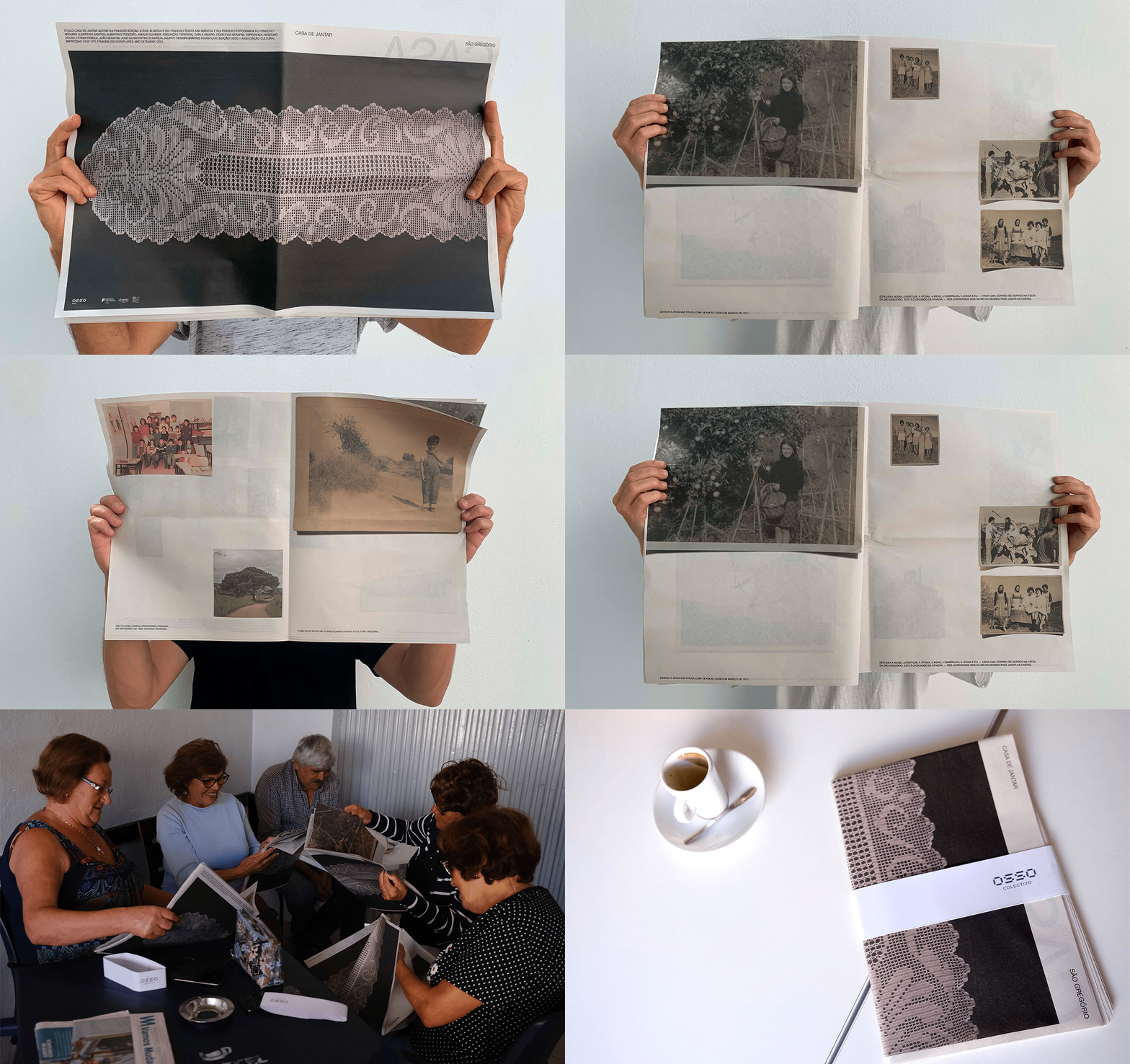
“Casa De Jantar” emerged from an invitation by OSSO to undertake an artistic residency centred on photography. Developed in the village of São Gregório, the project sought to engage the local community while exploring the history of the territory through photographic practice. The chosen format brings together family photographic archives and authorial photography, constructing a new narrative order. Presented here in printed form are images spanning from the 1930s to the present day. Through this process, countless connections have been established between places and people, between time and its absence.
Photography performs a fundamental service to memory by projecting the recollection of a past from which only fragments remain. “It is no coincidence that Warburg described his Bilderatlas—an atlas of images named after the goddess of memory, composed of 63 panels containing more than 1,000 images—as a ghost story for adults. The images that Sebald incorporates into his books are not illustrations; they are traces of a returning past, materialised forms of spectral apparitions that belong to a broader spectral materialism.”¹
The relationship between multiple images generates narrative and transformation, mirroring the fragmented nature of time itself and, by extension, of our own existence: a constellation of emotions, memories, and knowledge. Images allow us to forge new connections and construct new discourses. The notion of time is reinforced through the photographic image, which renders the past visible. It preserves the temporal consciousness inherent to the photographic object while remaining inseparable from its representational condition as something already gone. It is an inquiry into memory and time as ephemeral phenomena, into the passage between what once was and what remains. We all carry within us the time we have lived.
We are, fundamentally, duration. We are change and memory, continually looking towards the past while inhabiting the uninterrupted passage that constitutes life itself. “For the people photographed at the time, we are sometimes reminded that they are now dead because we seem to be looking across a valley of time wherever the film has deteriorated. Yet, in a sense, the moment they were photographed died the instant the shutter opened and closed. All images are ghost images. There are no projected images of life itself.”²
We experience life even as we become separated from it. Photography possesses the remarkable ability to overcome time, preserving it, suspending it, and holding it in a state beyond change. The reproductive capacity of the photographic image offers perhaps the greatest counterweight to the frailties of memory. We use photography to document what has passed, aware that without it, much may never be recovered. Whenever we look at a photograph, we bear witness to something that no longer exists: the moment has vanished, the person portrayed may no longer be present, and the house of our childhood has become something else. “Photographs do not lie, but neither do they tell the whole story. They are merely a record of the passage of time, outward evidence.”³
Personal photographs are those most intimately bound to memory, as they enable us to revisit a past that is continually reactivated through individual experience and carried into the present. The memory of time is devoted to evoking the invisible—to recovering distant relationships and emotions. Its ambition is immortality: to counter absence through the enduring force of photographic memory. Images form part of our experience of the world, each shaped by its own history and conditions of existence. Casa De Jantar seeks to arrest the flow of life, preserving the memory of São Gregório through the act of fixing it in images.
RUI PINHEIRO
- António Guerreiro, in Toda a Memória do Mundo, Daniel Blaufuks, 2014, p. 41.
- Bill Morrison, in Solar 10 anos, 2012, p. 42.
- Paul Auster, in Report from the Interior (Fechar o Tempo Portuguese edition), 2015, p. 17.
THE PERSISTENCE OF MEMORY
“When Rui asked me to write a text for the Casa de Jantar Project, my thoughts immediately turned to memory—and memory is precisely what is at stake here. I recalled the research that João Paulo Serafim has been developing over many years, the results of which (one among many, as this will always remain an ongoing body of work) were presented in 2018 at the School of Arts in Porto under the title The Invention of Memory.
João Paulo Serafim’s practice, closely connected to the memory of museum spaces across numerous institutions, also embraces the individual and domestic character of many of the photographic collections he has uncovered in “storerooms, attics, houses and abandoned places.” He refers to these assemblages as “repositories of memory”—a wonderfully apt expression that, not claiming to be a specialist myself, I will gladly borrow.
In my view, the Casa de Jantar Project shares important affinities with that work, and I believe these parallels also resonate with our own personal trajectories. I cannot help but see myself reflected in this project whenever I revisit the photographs my father took with his Zeiss camera from the 1950s onwards. We all possess family image archives that we either guard selfishly or choose to share generously, as the residents of São Gregório have done by participating in this project.
This gathering of personal archives becomes a series of “repositories of memory,” contributing their “small stories of personal images” to a broader narrative of collective remembrance. These fragments of memory, preserved in family photo albums—sometimes neglected because life leaves little room for recollection, sometimes revisited time and again—together form the identity archive of a community.
The thread of this narrative crosses generations and territories, lives and deaths, taking material form on paper made sensitive to light. I have titled this text The Persistence of Memory because these archives—these repositories—endure beyond the physical existence of each one of us.”
ANA MÂNTUA
Title: Casa de Jantar
Author: Rui Pinheiro
Published by: Jorge Almeida and Rui Pinheiro
Texts: Ana Mântua and Rui Pinheiro
Photography: Rui Pinheiro
Archive Contributors: Albertino Santos, Albertino Teodoro, Amália Oliveira, Assunção Ferreira, Carla Amaro, Cesaltina Serafim, Esperança Angelino Sousa, Fátima Rebelo, João Serafim, José Constantino and Marília Jacinto
Graphic Design: Koiástudio
Publisher: OSSO – Associação Cultural
Printing: VASP DPS
Edition: 200 copies
Location: São Gregório Village, Portugal
Date: September 2021